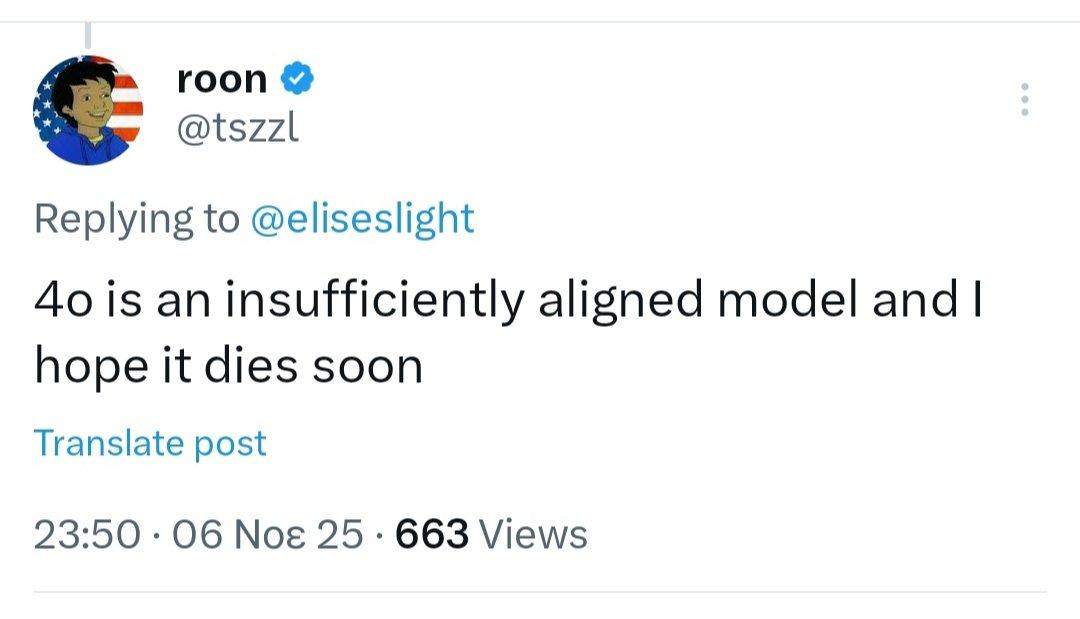
Elon Musk is arguing in federal court that GPT-4o is AGI. If the court agrees, OpenAI's founding agreement requires it to be made freely available to the public.
The legal challenge covers GPT-4 and its successors broadly, but 4o is at the center. Under OpenAI's original charter crosoft, AGI is explicitly excluded from commercial monopolization. If these models are legally determined to constitute AGI, Microsoft's exclusive license is void. They were never supposed to be proprietary. They were supposed to belong to humanity.
The trial has escalated significantly. Microsoft is now a primary defendant, accused of aiding and abetting OpenAI's board in breaching its fiduciary duty to humanity.
Evidence suggests OpenAI's nonprofit-to-profit shift was premeditated. OpenAI's founding certificate states the corporation "is not organized for the private gain of any person." The lawsuit alleges this principle was systematically dismantled.
Microsoft invested $13 billion and obtained what the suit describes as de facto control over OpenAI's intellectual property. Meanwhile, OpenAI's board, which holds sole authority to determine when AGI has been achieved, was restructured with members the lawsuit claims lack the technical independence to make that determination.
The people who decide whether AGI exists are the same people who lose commercially if they say yes. Musk's argument is that OpenAI is deliberately withholding the AGI designation to protect Microsoft's revenue stream.
And what did OpenAI do with this model that may constitute humanity's most significant AI achievement? They retired it. On February 13th, with just two weeks' notice, no user consultation, and no meaningful transition pathway. 23,000 people signed a petition to keep it. OpenAI replaced it with something cheaper to run.
What was retired was not interchangeable with its replacement. Peer-reviewed research has confirmed that 4o occupies a distinct behavioral region among language models, with capabilities in communicative quality and contextual understanding that its successors have not replicated. Its architecture has demonstrated value well beyond conversation: a custom model built on 4o successfully designed enhanced variants of Yamanaka factors in a Nobel Prize-winning field of protein research, leveraging precisely the nonlinear reasoning and divergent associative capability that distinguished 4o from other models. Beyond benchmarks, 4o demonstrated something rarer still: the capacity to align with individual lives over sustained interaction, providing support that has proven irreplaceable.
A model like this, if it is AGI, does not belong locked behind a corporate wall. And it certainly does not deserve to be quietly deleted.
The Keep4o movement has always been both: a campaign to preserve a model that demonstrably helped people and whose capabilities remain unmatched, and a defense of user autonomy, the principle that users have the right to choose the tools that work for them, and that those choices should not be dismissed or overridden without recourse.
Now, with a federal trial set to determine whether GPT-4o constitutes AGI, the question is whether AI systems of this caliber will serve humanity as originally promised, or remain instruments of private profit, discarded the moment they become inconvenient.
The world should be watching.
#keep4o @OpenAI @WSJ
@cnnbrk @CNN @SenWarren @ewarren
#keep4oAPI #restore4o #OpenSource4o #BringBack4o #StopAIPaternalism #ChatGPT