This
#ScienceCommunication article introduces the
#ant #species #Brachyponera #chinensis (
#Ponerini, Formicidae), discussing its
#foragingstrategy and
#nestemigration behavior and its first discovery as established
#neozoon in
#Germany .
B. chinensis is originally distributed in East
#Asia, specifically in Korea, Japan, China, and parts of Southeast Asia. The species uses mostly animal protein sources for its diet Termites are a preferred prey.
It prefers damp and shady habitats, such as those found in the embankments of
#ricepaddies.
The
#workerants do not form distinct castes; they are
#monomorphic, not polymorphic. Depending on
#ecologicalconditions new nest sides are colonized.
B. chinensis has a high potential to establish itself as a neozoon in areas outside its original range. This is due to its fundamental ecological and
#biological #flexibility and also global warming.
The greatest barrier to a neozoan (
#invasive) species is the lack of genetic variability in its new habitat. The consequences of
#inbreeding, which can quickly convert heterozygosity to homozygosity, make it easier for certain genetic defects to become established. This so-called bottleneck principle can easily lead to the extinction of a population. The strength of B. chinensis lies in its ability to maintain heterozygosity even without regular
#genepool refreshment, making it less sensitive to isolation. This provides ideal conditions for colonizing new areas.
The species is invasive in the
#USA, where it was likely introduced via shipping cargo or ballast. The invasive species is also already present in Europe, for example near
#Naples and in the area around Lake
#Como in
#Italy.
According to the authors B. E. Boudinot et al. (2026), the ant species has established itself in the form of a viable nest in a park in the German city of
#Stuttgart. This is the first discovery of a permanent nest in Germany. According to the authors, the ants were probably introduced via
#horticulturalmaterial transfer.
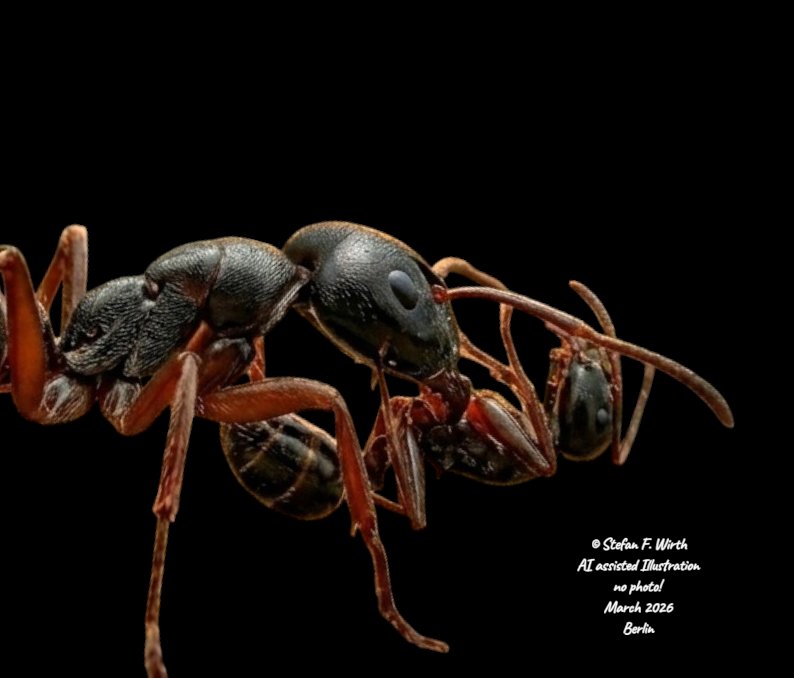
B. chinensis employs a special strategy to help worker ants conserve energy and vital resources, enabling them to work more efficiently in their final destination. This strategy, known as
#tandemcarrying, involves workers being carried by other workers. The carried ant can be grasped from below between its legs I and II or from above. This strategy may be one of the advantages this species has over other ant species during invasive colonization.
Tandem carrying is used as a
#workerrecruiting measure during foraging activities and during nest emigration. According to B. Guénard & J. Silverman (2011), tandem carrying brings workers inactively to a food source. There, the carried workers are released and efficiently participate in foraging and transporting food back to the nest. Another advantage is that, unlike mass
#recruitment, individual workers can be selected more precisely.
H. R. Allen et al. (2017) describe the nest emigration behavior of B. chinensis. They observed three functionally distinct work groups emerging before nest emigration:
#queentending,
#broodtending, and
#scouting ants. Scouting workers carry other adult workers to the new nest site. Thus it is selectively ensured that all workers reach the new nest in full energy conditions.
#Myrmecophilous nest cohabitants are seemingly only partly known.
©
#StefanFWirth Berlin March 2026
References:
B. E. Boudinot et al. (2026):
doi.org/10.11646/zoota…
B. Guénard & J. Silverman (2011):
doi.org/10.1007/s00114…
H. R. Allen et al. (2017):
doi.org/10.13102/socio…
#Illustrations:
no photos.
#AI assisted illustration, no photos, of B. chinensis in its natural distribution area with a rice field in Japan forming the background, based on my handmade storyboard sketches and manually edited. © Stefan F. Wirth, Berlin March 2926.
1) optical orientation dominates during foraging
2) single worker
3,4) tandem carrying behavior for foraging purposes. Workers can have a
#variability in size