#PLA #China #Japan #Korea #India #Taiwan #Pakistan
Satellite images indicate a significant acceleration in the buildup of China's military aviation production. According to analysts at the Mitchell Institute for Aerospace Studies, AVIC Corporation has been actively expanding es in recent years, which is directly related to the increase in the production of both the latest stealth fighters and previous-generation aircraft.
Main expansion centers
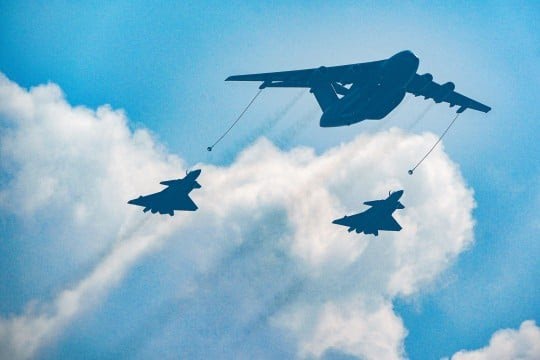
Chengdu (J-20 program):
- About 278,000 m² of production space has been added since 2021;
- Up to five assembly lines may be deployed;
- The potential output rate is up to 100–120 aircraft per year
Shenyang (J-35 program):
- A new factory with an area of over 370,000 m² is being built;
- The infrastructure includes a 3.6 km-long runway;
- The enterprise is focused on assembling both the carrier-based and ground-based versions of the J-35.
Changhe (helicopters):
- An increase of about 93,000 m², which corresponds to an increase of about +30% in existing capacities.
According to these estimates, AVIC is adding over 743,000 m² of production space - a scale that is comparable (and even exceeds) that of the large American F-35 assembly complex in Fort Worth.
What this could mean in terms of output rates
If the announced capacities are fully utilized, China could produce about 300–400 4th and 5th generation fighters per year in the coming years, and in a more conservative scenario - about 250 annually. At the same time, as noted, the production of 4th generation fighters (including the J‑15 and J‑16) continues.
Comparison with Western rates
For reference, the current volumes are given:
- Lockheed Martin - approximately 150 F‑35A/B/C per year;
- Boeing - about 24 F‑15EX;
- Dassault Aviation - 26 Rafale (for 2025).
Balance of forces and quality of platforms
In the US, it is traditionally emphasized that in terms of overall characteristics, Chinese aircraft allegedly lag behind their American counterparts; in particular, there have been statements that the J‑20 does not reach the level of the F‑35. However, even with the controversy of such assessments, it is the scale of serial production that can become a decisive factor.
If the current dynamics are maintained and new capacities are fully utilized, by 2029 China could theoretically form the largest fighter fleet in the world. In combination with the development of aircraft carrier forces, this expands China's capabilities to project power in both maritime and land-based direction