$NAT UNDER ATTACK 🚨
Exploit narratives.
Miner tension.
Bad incentives.
A lot of noise.
We break down what’s actually happening and why this moment could matter more than people realize.
How NAT Just Experienced Its Coming Of Age Moment! Miner Poisoning Explained!
Four miningPool, Ultimate Pool, and Mining Squared, all adopted the $NAT token within the same few hours, which initially felt like a major win. But as we dug deeper, something strange became clear: all four of these pools share a connection to @AntPoolofficial, the original $NAT mover. A research article by Bitcoin developer B10C on Bitcoin mining centralization in 2025 confirmed it, @Braiins, @CloverPool_com, @AntPoolofficial, @ultimus_pool, and others are all listed together as "Antpool and friends." The fact that only these four affiliated pools adopted $NAT simultaneously, while others did not, made us pause.
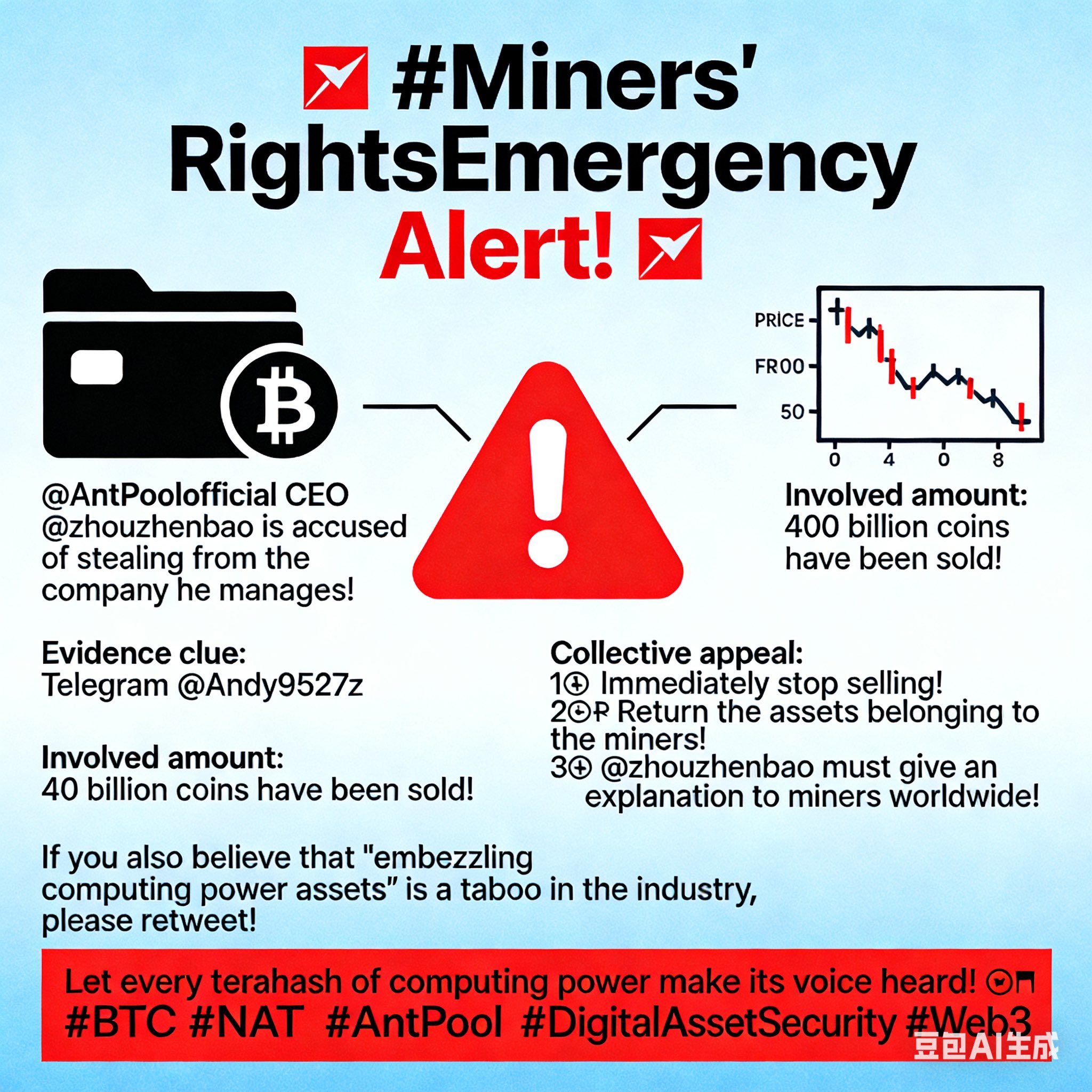
The situation escalated quickly. We noticed that all four pools sent their $NAT tokens to a single wallet address, which is a major red flag. Independent mining entities don't typically consolidate to one address unless something coordinated,or something wrong, is happening. Sure enough, that address proceeded to dump all the $NAT at roughly a 50% discount. It was absorbed almost instantly by people who understood the opportunity. This was not a legitimate adoption, it was a scam exploiting a real vulnerability in the protocol.
The attack vector is what's known as transfer poisoning. Antpool and its affiliated pools use a shared technology stack that automatically signs all UTXO outputs. A sophisticated attacker sent a transfer inscription to those pool addresses. Because the dispatcher automatically processes UTXO outputs and a token send encodes the recipient address of the attacker, the transfer was completed without any manual confirmation. @FoundryServices was also targeted, but because Foundry does not auto-sign all UTXO outputs the same way, the attack failed there, validating exactly where the vulnerability lived.validating exactly where the vulnerability lived.
@rarity_garden and the @natgmi development team responded fast. A mandatory protocol update was implemented, requiring miners to opt into an unlocking step before they can transfer $NAT, essentially inscribing an intent to their own address first. This opt-in inscription prevents transfer poisoning because attackers can no longer trigger an automatic send. It's a clean, elegant fix.
This kind of event has a historical precedent. Bitcoin itself had a critical overflow bug in August 2010, barely a year after launch, where a hacker generated 184 billion BTC in a single transaction. Satoshi and developers patched it within five hours. @ethereum had the DAO hack. These events aren't the end of a protocol; they're stress tests that force improvements and build long-term resilience. The fact that NAT's response was equally swift is a positive signal, not a catastrophe.
The bigger takeaway here is awareness. The only real long-term defense is making sure every Bitcoin miner knows about NAT. Pools like @ViaBTC , @f2pool, and @SpiderPool_com were not compromised because they operate outside the Antpool technology stack, but that's not the point. If Antpool is already moving and selling NAT rewards, their customers, the miners using their infrastructure, deserve to know this is happening and how to protect themselves. Centralization in mining isn't just a philosophical concern; it creates systemic exploitable surfaces. And as the Bitcoin security budget conversation grows louder, NAT's role in solving that problem will matter more, not less. Pay attention to the organic ones.